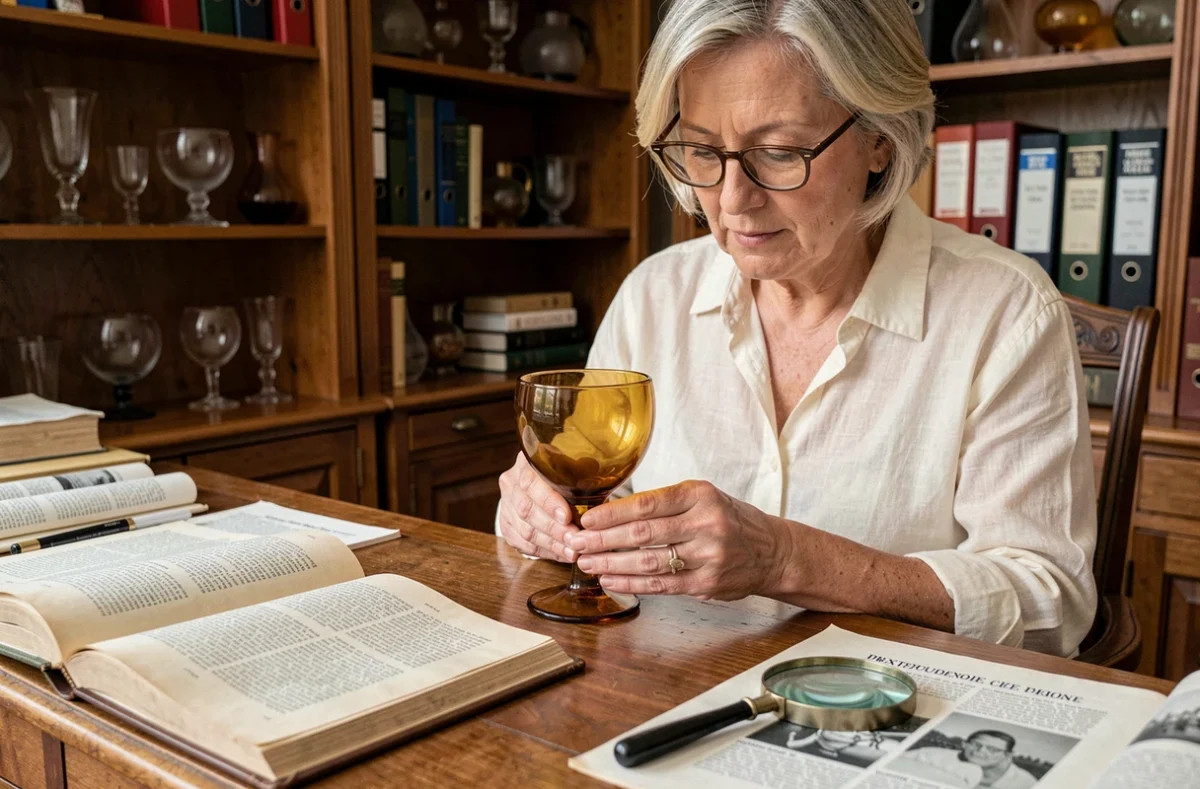
You found a colored glass at a flea market, turned it over, and read “Portieux” engraved in the glass. This begins a sometimes frustrating search: what model does this piece correspond to, what was its original color, does it belong to a complete set? The Portieux glassware catalog is the key to answering these questions, but accessing it requires knowing where to look and how to utilize the right resources.
Identifying a Portieux piece without a period paper catalog
The old commercial catalogs of the Portieux glassworks referenced several thousand models. These paper documents, printed for representatives and wholesalers, were not intended for the general public. Today, original copies are rare and are traded at high prices among collectors.
The main difficulty lies in the diversity of production. Portieux manufactured glasses, carafes, bowls, vases, candlesticks, and decorative objects in a very wide color palette (opaline, blue, green, pink, amethyst). The same model could exist in more than ten different colors, which complicates identification without a reliable visual reference.
Before consulting a catalog, note three elements about your piece: the general shape (chalice, tumbler, flared bowl), the color and transparency of the glass, and any mark or engraving under the foot. These three criteria allow for quick filtering of results in any documentation database.
To access digitized reproductions and detailed sheets, consulting the online Portieux glassware catalog is a structured starting point that gathers the main references useful to collectors.

Online resources to find Portieux glassware references
You may have noticed that Google results for “Portieux catalog” often lead to Pinterest boards or sales listings? These pages show photos without context: no model number, no production date, no technical description. To go further, it is necessary to combine several types of sources.
Specialized heritage blogs on glassware
Some enthusiasts have photographed and commented on entire pages of period catalogs. The blog “Le Verre et le Cristal,” for example, documents pieces from the Portieux glassworks with reproductions of commercial plates. These blogs remain the most accessible source to visually compare a piece with a referenced model.
The Joconde database of the Ministry of Culture
Less known to collectors, the Joconde database catalogs objects preserved in museums in France. It contains several hundred thousand records. A targeted search for “Portieux” can reveal documented pieces in public collections, with precise descriptions (material, dimensions, manufacturing technique).
The Joconde database allows for verifying the authenticity of a model by cross-referencing its description with that of a museum piece. It is a verification tool, not a comprehensive catalog.
Collector groups on social media
Active communities share photos of Portieux pieces daily on Facebook. The advantage: you can post a photo of your find and get identification within hours from experienced collectors. The downside: responses are not always sourced and may contradict each other.
- Heritage blogs: reproductions of catalog plates, historical descriptions, free access but dispersed content
- Joconde database: verified museum records, useful for authentication, keyword search
- Facebook groups: quick identification by the community, but reliability varies by contributor
- Auction sites (Drouot, eBay): sometimes detailed descriptions with model numbers, useful as a supplement
Differentiating Portieux, Vallerysthal, and copies: common pitfalls
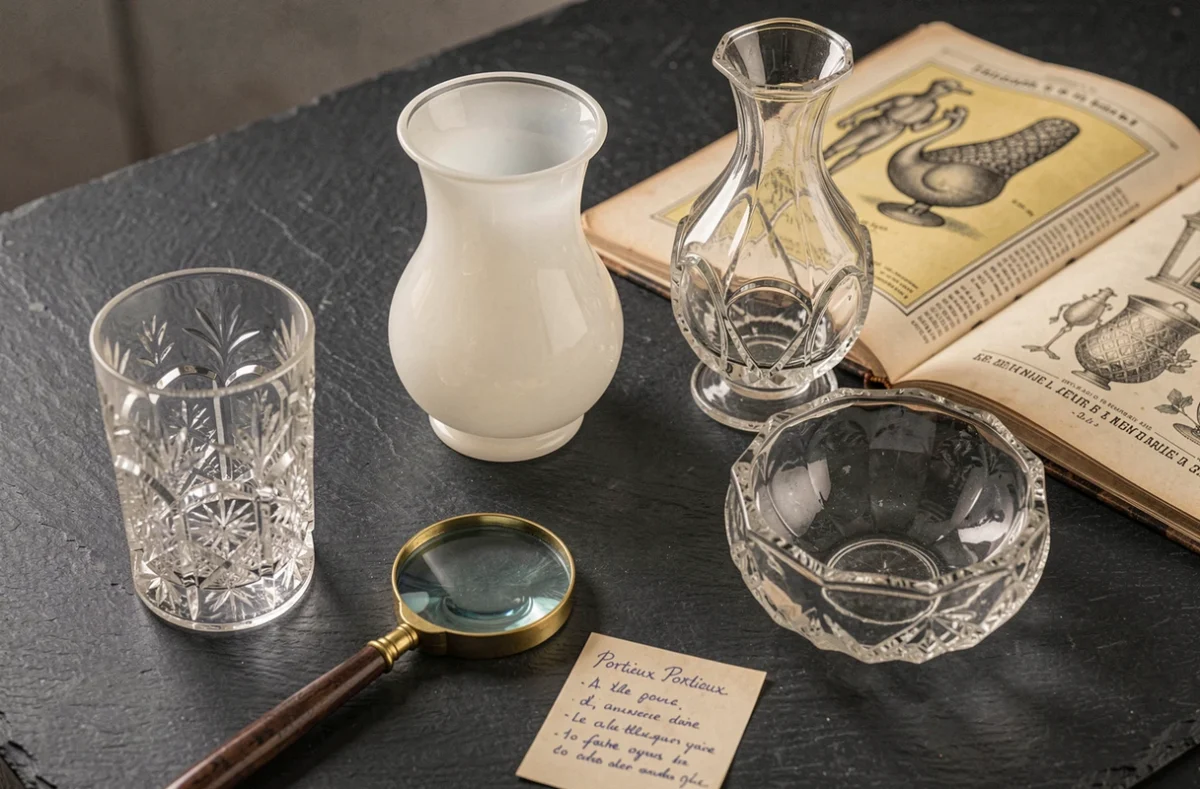
The Portieux glassworks merged with Vallerysthal in the 19th century. This alliance led to cross-productions: some pieces bear the Portieux mark but were made at the Vallerysthal site, and vice versa. Post-merger catalogs sometimes feature both names on the same page.
For a collector, this confusion is not trivial. A piece stamped “PV” (Portieux-Vallerysthal) does not have the same value as a Portieux piece from before the merger. The catalog allows for dating a model based on its production period.
Copies represent another trap. Portieux produced glass and crystal with a lower lead content than major houses like Baccarat. Some pressed molded glass pieces made by other Lorraine glassworks closely resemble Portieux models. Two clues help to tell the difference:
- The weight: Portieux crystal is denser than ordinary glass but lighter than high-lead crystal
- The sound: a Portieux crystal glass produces a clear sound when tapped, while ordinary molded glass sounds dull
- Molding marks: molded Portieux pieces often show fine, regular seam lines, a sign of precise tooling
Building a coherent Portieux collection using the catalog
Accessing the catalog is not only useful for identifying isolated pieces. It allows you to reconstruct complete sets by identifying all elements of the same series: water glasses, wine glasses, champagne bowls, matching carafes.
A complete Portieux service in good condition is valued much more than mismatched pieces. The catalog indicates the standard compositions of each service, allowing you to know exactly which pieces are missing from your collection.
Focus your searches on a specific period or style. Portieux’s production spans over two centuries, from the founding of the factory in the early 18th century to its final closure in 2021. Choosing a decade or type of piece (the opalines of the 1920s, the colored footed glasses of the post-war era) gives a clear direction to your collection and facilitates searches in the catalogs.
Patience remains the best asset. Portieux pieces regularly circulate at flea markets and online sales, often poorly identified. A collector who knows their catalog spots opportunities that others miss simply because they know what they are looking at.